
Translational Infectious Disease Research Summit
Global Voices with Shared Impact
Olink Proteomics World 2025
Be Part of the Global Proteomics Movement – Watch Olink Proteomics World
The sessions are organised in three tracks, each featuring cutting edge science with insightful discussions and practical suggestions:
Multiomics & Precision Health – Discover how proteomics complements GWAS, fuels new hypotheses using UK Biobank data, and drives workflow standardization.
Population Proteomics – Join expert panels on increasing diversity in cohort studies and see how combining MS and affinity-based platforms expands proteome coverage.
Disease-Focused Applications – Dive deep into neurology, oncology, and infectious diseases. Get practical tips on proteomics and translational impact.
Want access?
Register to hear from 9 global experts across 8 talks covering vaccine response, immune profiling and pathogen surveillance. Gain valuable insights into how translational science can drive meaningful change.
Register for access
Advancing infectious disease research requires more than innovation, it requires connection. The Global Infectious Disease Translational Research Summit convenes a diverse community of researchers, cohort leaders, public health experts, funders, and industry partners committed to translating science into impact.
Focused on emerging and high-burden regions, this summit highlights the power of collaboration in tackling challenges such as limited resources, fragmented data, and the need for rapid, scalable solutions.
Through discussions on vaccine response, immune profiling, and pathogen surveillance, participants will gain insights into how translational science can drive meaningful change.
Join a global network of experts working at the intersection of discovery and implementation and be part of shaping a more connected, effective future for infectious disease research.
Welcome
Speaker: Evan Mills, VP Global Business Development
(Olink, part of Thermo Fisher Scientific)
From Discovery to Precision Medicine: Deciphering the Immune Biology of Long COVID
Speaker: Professor Douglas D. Fraser, MD, PhD, FRCPC
Key Takeaways
Long COVID requires deeper biological characterization - The study showed that Long COVID varies widely by geography, symptoms, and patient clusters. Clinical symptoms and demographics alone were not enough to identify actionable subgroups, leading to use proteomics to better understand the underlying complex biology.Revealing sustained immune disruption - Using Olink HT to measure more than 5,400 proteins, this lead to identified persistent biological differences in Long COVID-positive patients, including chronic immune activation, T cell exhaustion, altered cellular trafficking, cellular stress, and changes related to blood cell formation.
Proteomic insights supported therapeutic prioritization - The study identified 13 hallmark pathways that were consistent across sites and symptom clusters. These findings informed AI-enabled drug repurposing and helped prioritize upadacitinib and pirfenidone for evaluation in the LC Revitalized Phase 3 clinical trial.
Multiplex protein and antibody profiling in infectious diseases
Speaker: Professor Peter Nilsson
(SciLifeLab, Dept Protein Science, KTH Royal Institute of Technology, Sweden)
Key Takeaways
Multiplex profiling connects host proteins and antibody responses - The use of affinity proteomics and antibody profiling to study infectious diseases, with emphasis on combining circulating protein profiles, autoantibodies, and virus-targeting antibodies in complex multiplex analyses.Pan-disease profiling helps distinguish infection-related protein patterns - Using the Human Disease Blood Atlas, Dengue and Malaria displayed distinct circulating protein patterns, including higher IFNL1 in dengue and HMOX1 in malaria, while emphasizing that pan-disease profiling is important because case-control studies may not capture disease specificity.
Large-scale serology supports infectious disease preparedness - Antibody profiling from COVID-19 serology to broader pandemic preparedness, adding antigens for respiratory viruses, vaccine-related pathogens, herpes, tuberculosis, and arboviruses. Current work included large-scale seroprevalence studies, including 2,700 South American region serum samples.
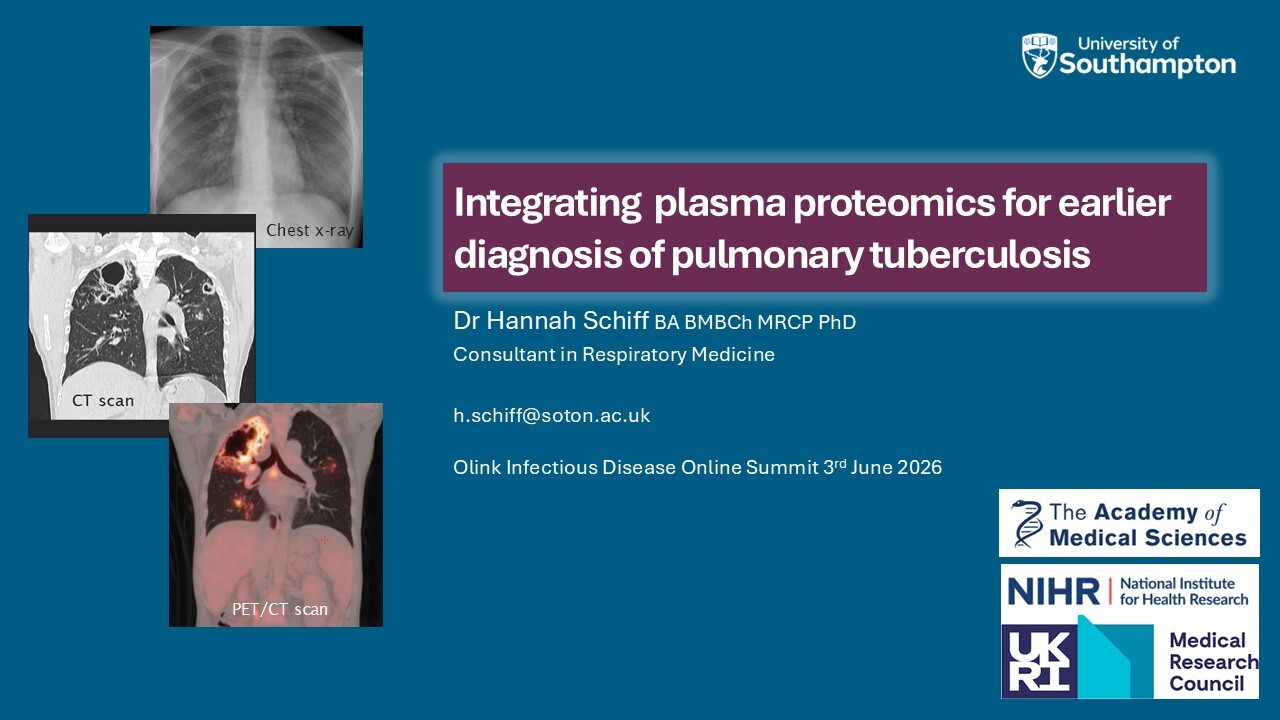
Integrating plasma proteomics for earlier diagnosis of pulmonary tuberculosis
Speaker: Dr. Hannah Schiff, Respiratory Consultant & Senior Clinical Lecturer
(University of Southampton)
Key Takeaways
Earlier TB diagnosis remains a critical unmet need - Dr. Schiff emphasized that pulmonary tuberculosis remains a major global infectious killer, with diagnostic delays contributing to cavitary lung disease, sputum smear positivity, infectiousness, and a persistent case detection gap that current diagnostics have not fully addressed.Integrated plasma proteomics identified candidate TB biomarkers - Using discovery mass spectrometry followed by Olink PEA for verification, the study identified 118 candidate plasma biomarkers, 55 of which were measurable using Olink panels, enabling verification in carefully characterized TB, healthy control, and symptomatic control cohorts.
A six-protein panel showed potential for TB triage - The six-protein panel distinguished microbiologically confirmed pulmonary TB from healthy and symptomatic controls, with potential for diagnostic performance meeting the WHO target product profile for a non-sputum-based TB triage test in the presented validation analysis.
Elevated HLA-DQ levels associated with T cell immunity in yellow fever vaccination
Speaker: Eugenia Z. Ong, PhD, Principal Research Scientist
(Duke-NUS Medical School Singapore)
Key Takeaways
Cellular immunity was linked to viral control after challenge - The study used sequential yellow fever 17D and Japanese encephalitis vaccination to examine cellular protection. Aviremic subjects showed higher capsid-specific T cell responses, which negatively correlated with challenge vaccine RNA levels after vaccination.HLA-DQ signatures distinguished aviremic from viremic subjects - Whole blood transcriptomic profiling showed higher HLA-DQA1 and HLA-DQB1 transcripts in aviremic subjects. Pathway analysis also showed enrichment of innate immune and antigen-presentation gene modules at baseline in aviremic subjects
Cytokine profiling connected HLA-DQ with lower inflammation and stronger T cell signals - Higher HLA-DQ levels correlated with lower PGF, FLT1, IL-6, and CXCL-10 inflammatory signals, while aviremic subjects showed higher interferon gamma and Granzyme B by day 10 post-vaccination.
.jpg?width=1280&height=720&name=Olink%20ID%20Summit_Eugenia%20Ong%20(final).jpg "Olink ID Summit_Eugenia Ong (final)")
From a systems to mechanistic understanding of the immune response during and after acute malaria
Speaker: Christopher Sundling, Principal Researcher and Group leader
(Karolinska Institutet, Sweden)
Key Takeaways
Malaria immunity involves both resistance and tolerance - Clinical immunity to malaria does not necessarily prevent infection or parasitemia. Instead, repeated exposure can reduce disease severity, suggesting the immune system adapts to limit harmful inflammation during blood-stage malaria.Protein profiling mapped inflammatory dynamics during and after acute malaria - Protein profiling with cellular and clinical data, the team identified early inflammatory responses, delayed cellular activation, and later immune changes. Deeper analysis found more than 500 proteins elevated during acute malaria versus convalescence
Prior malaria exposure was associated with reduced inflammatory responses - Previously exposed individuals showed lower inflammatory protein responses than primary infected individuals. Antibody levels, especially parasite-specific IgG3, were negatively correlated with inflammatory cytokines and gamma delta T cell expansion, suggesting antibodies may help reduce inflammation
Panel discussion
Infectious Diseases 2026: Innovation vs. Inevitability
Panelists:
Professor Christophe Rodriguez, Head of GenoBioMICs platform
(Henri Mondor University Hospital (Assitance Publique des hopitaux de Paris), INSERM U955, Paris Est Creteil University)
Zulfiqar Abbas, Vice President & General Manager, Middle East & Africa
(Thermo Fisher Scientific)
Moderator: Sarantis Chlamydas, Senior Scientific Lead - MultiOmics Strategy, Innovation & Alliances
(Olink, part of Thermo Fisher Scientific)
Key Takeaways
Pandemic preparedness depends on data integration, not just data generation - Emphasis that COVID-19 accelerated sequencing, diagnostics, and surveillance capacity, but exposed major gaps in data analysis, metadata sharing, ethics, interoperability, and real-time interpretation across laboratories, countries, public health authorities, clinicians, and researchers.Proteomics can add host-response insight to infectious disease decisions – the panel highlighted that pathogen detection alone may not prove causality or predict patient outcome. Host-response proteomic signatures were discussed as a way to support outbreak assessment, classify patients, and distinguish severe from mild disease trajectories.
Clinical translation requires standardization, affordability, and clear reporting - The discussion identified standard protocols, scalable access, regulatory clarity, and simple clinician-facing outputs as key needs for moving proteomics into clinical use. Panelists also stressed that proteomics would support the full pathway from discovery to clinical translation determining diagnosis and treatment outcomes.
Want access?
Register to hear from 9 global experts across 8 talks covering vaccine response, immune profiling and pathogen surveillance. Gain valuable insights into how translational science can drive meaningful change.